TL;DR: The standard audiobook subscription – one credit a month, your unused credits quietly evaporating – was designed for the platforms, not for listeners. In 2026, there are better ways to buy audiobooks in the UK: pay-per-book pricing with no monthly commitment, and prices that get cheaper the more you listen rather than more expensive. Here’s why the model is broken, what the alternative looks like, and how to know which is right for you.
The deal nobody read the small print on
When subscription audiobook services launched, the pitch was reasonable. Pay a flat monthly fee, get one audiobook a month. Easy. Predictable. Definitely cheaper than buying every book individually.
A decade later, the small print has caught up with everyone.
If you’re paying around £8–10 a month for one credit, that’s £100+ a year before you’ve even decided what to listen to. And life isn’t that tidy. You started a new job. You had a baby. You moved house. You got really into a podcast for two months. The credit you were definitely-totally-going-to-use-this-time sits there, expires, or gets quietly absorbed by the platform’s accounting.
The honest truth that big-tech audiobook services don’t put on their landing pages: most people on audiobook subscriptions buy fewer audiobooks per year than they would if they paid per book — they’re just paying more for the privilege.
The maths is upside down
Here’s the part that doesn’t get explained well. The unit economics of a one-credit-a-month plan only really work if you listen to exactly one audiobook a month. No more, no less.
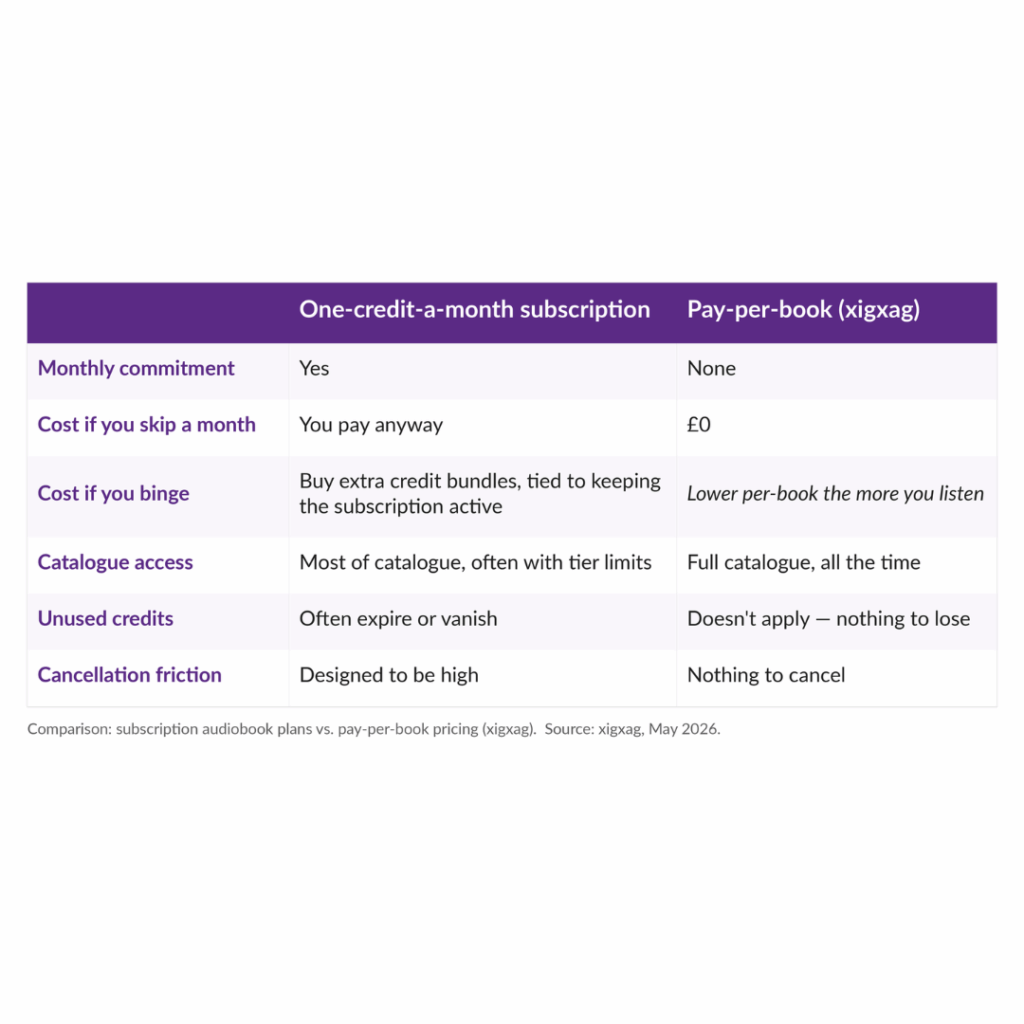
Listen less, and you’re overpaying — buying credits you’ll never use.
Listen more, and you’re stuck topping up via “extra credit” bundles, in fixed pack sizes, tied to keeping your subscription active. The credits work fine when used — but the structure forces planning ahead, locks the spend into the subscription relationship, and hides the fact that any credits left unused at cancellation typically expire. Heavy listeners — what the industry calls binge listeners, roughly the top 15-20% of the market — get the worst of both worlds: a monthly fee they’re already over-using, plus the friction of bundle top-ups whenever they want to read more than one book a month.
For everyone in the middle, it’s a soft lock-in that survives because the monthly fee sits just under the threshold most of us can be bothered to cancel.
What “no subscription” actually means
The alternative is older than the idea of subscriptions, and it’s also simpler: pay for the books you want, when you want them.
No monthly commitment. No credits to keep track of. No auto-renewing direct debit you forgot about. No “use it or lose it” pressure to start a 17-hour fantasy doorstopper on the 28th of the month.
At xigxag, this is how we run. Every audiobook is priced individually. You pay only for what you actually listen to. And — here’s the bit that flips the subscription model on its head — the more full price audiobooks you buy across a year, the cheaper every subsequent book gets. Our pricing tiers unlock lower prices after every five audiobooks and reset annually. The opposite of the subscription model, where the more you “save” the more leftover credits you’ve actually paid for and never used.
Subscription vs. pay-per-book: the quick comparison
But isn’t the subscription cheaper if I do listen one a month?
It’s the right question. The honest answer is “barely, and only if everything goes perfectly.”
A monthly credit averages around £8-10 per audiobook on the subscription side. On a pay-per-book model, full-priced new-release bestsellers come in a couple of pounds above that — but most of the catalogue, especially anything that isn’t on this week’s bestseller list, runs well below. Across a year, the listeners we talk to consistently report two things after switching: they spend less and they listen to more books, because they’re not rationing themselves to one credit a month.
The simplest test you can run on yourself: open your current audiobook subscription account and check how many unused credits are sitting there. If it’s more than one, you’ve just proved the case against subscriptions to yourself. 💸
A quick disclosure
We’re xigxag, an indie UK audiobook platform. We built our pricing model as the deliberate opposite of one-credit-a-month because we hated being on the receiving end of it as listeners ourselves. We’re a B Corp, audio-first, anti-AI-narration, with the listen-and-read x-book® format and 96% of the UK Sunday Times bestsellers in the catalogue. We’re a small UK business — based in Cornwall, not in America.
You don’t have to take our word for any of this. But if you’ve ever stared at a stack of unused audiobook credits and thought “there has to be a better way to do this” — there is.
FAQ
Are audiobook subscriptions ever worth it? For listeners who reliably consume exactly one audiobook a month, every month, and don’t want to think about price, a subscription can work fine. For most other patterns — listening more, less, or in bursts — they’re poor value, and the longer you stay on one the more obvious that becomes.
Can I get audiobooks without a monthly subscription in the UK? Yes. xigxag offers more than 120,000 audiobooks on a pay-per-book basis with no monthly fee, no credits, and tiered pricing that gets cheaper the more you listen across a year. There are also a small number of other independent options, including Libro.fm.
What about Spotify and Apple Books? Spotify includes audiobooks in its Premium plan which cost £12.99 per month, so not cheap, and caps usage at around 15 hours a month, which is fine for casual listening but restrictive for anything longer or for re-listening. Apple Books and Google Play sell audiobooks à la carte, but neither has invested heavily in the format and the experience reflects that.
How does xigxag’s pricing actually work? You pay per audiobook. Typical prices run from a few pounds for catalogue titles up to around £20 for new releases — broadly in line with the rest of the market on retail price. Listen to five books in a year and you unlock the next tier at lower prices. Listen to none in a given year and you owe nothing — there’s no monthly fee in the background.
Is there a catch? The catch, if you can call it one, is that it requires you to make a small decision each time you start a new book — what to listen to next, whether you want to buy it. Subscriptions remove that decision in exchange for charging you whether or not you listen. We think the small decision is the better deal. You may, reasonably, disagree.
Written by the xigxag team — UK-based, B Corp certified, audio-first. If you’re sick of audiobook subscriptions, come and have a look at xigxag. No commitment, no credits, no AI narration. Just audiobooks, but better.
